

Places for People: Cafes and Third Spaces
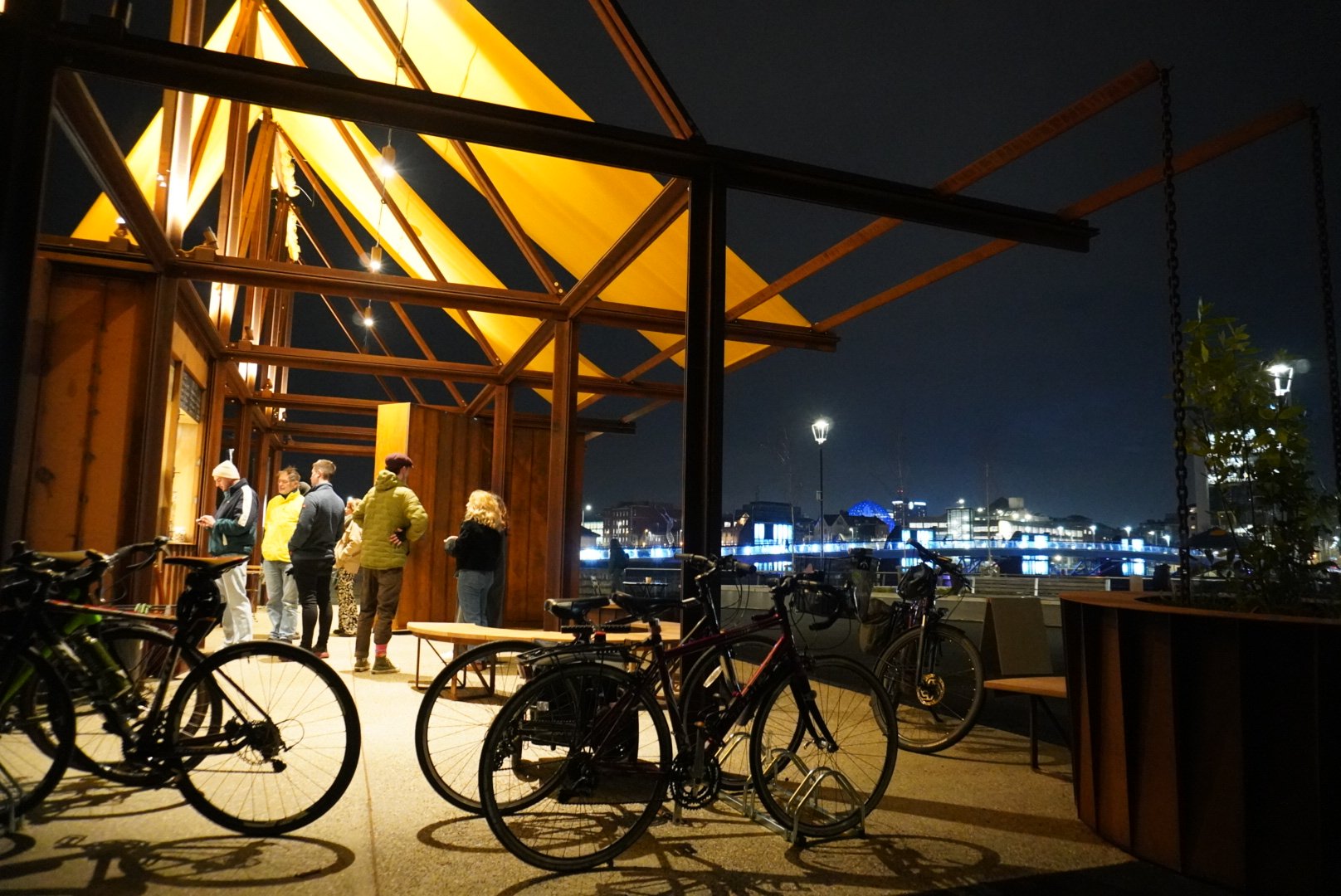
Cyclists enjoying a crisp Friday night by the Lagan
Coffee spaces - especially independent local ones - act as informal “third places”: accessible hubs for social interaction, creativity, and quiet reflection. They create vibrancy, support footfall, and subtly shape public life. The term third space, coined by sociologist Ray Oldenburg, refers to places that are neither home nor work. He described them as accessible and inclusive; welcoming to regulars yet comfortable for those who want to stay low-key; and full of space for conversation and playfulness.
This kind of social infrastructure is vital for a healthy, thriving society. We saw this clearly in 2020. When the Covid-19 pandemic hit, it became obvious how important these places were, and it’s actually how Native began. We set up a mobile coffee trailer along the County Down Coast, and it quickly became a beloved spot for locals and visitors to catch up safely, breathe in the sea air, and reconnect. Before long, it had become a much-needed gathering place.
“What counts as social infrastructure? … Public institutions such as libraries, schools, playgrounds, parks, athletic fields, and swimming pools are vital parts of the social infrastructure. So too are sidewalks, courtyards, community gardens, and other green spaces that invite people into the public realm… Commercial establishments can also be important parts of the social infrastructure, particularly when they operate as what the sociologist Ray Oldenburg called ‘third spaces’…”
Cities need places where people can relax without spending much (or anything at all) while still feeling part of everyday social life. These places foster a sense of belonging, which is more than a pleasant feeling; it’s fundamental to our wellbeing. Research links belonging to greater resilience, motivation, mental health, and even physical health. Third spaces create that feeling in simple, accessible ways. You don’t need to strike up a conversation with a stranger, you can simply be around others, sharing a quiet moment together.
Philosopher Simone de Beauvoir once described spending entire winter days in Café de Flore during 1942–43, arriving early to sit next to the stovepipe for warmth. “We always had a shock of pleasure, emerging from the cold darkness, coming into this warm, bright den,” she wrote. Those who gathered there became a “family” of regulars. “We felt at home, safe.”
Why are they so important?
Think about the savings and social benefits that come from healthier, happier communities. We’re living through several societal crises, one of the most pressing being the global loneliness epidemic. The World Health Organization has officially declared loneliness a “global public health concern.” A new wave of third places — community hubs, repair cafés, libraries of things, coffee kiosks, and low-key spaces for groups to meet could be part of the solution.
What’s interesting about Belfast?
Belfast has a vast amount of unused space; land sitting idle or reserved for cars, contributing little to social life. Many of these spots are earmarked for future development, but why wait to unlock their potential? Through Queen’s Quay Kiosk and projects like Brink! and Trade Market, the city has opened itself up to the idea of meanwhile use: the temporary activation of vacant or underutilised spaces to create cultural, social, or economic value. As outlined in frameworks like Meanwhile City, these low-risk, high-reward projects allow councils and communities to test ideas, build momentum, and bring life to areas awaiting long-term transformation.
Belfast is full of potential, not just in its buildings, but in its people. Third spaces remind us that small, everyday interactions matter. A shared smile, a quiet moment, a familiar face across the counter - these are the threads that hold a city together.
At Native, we’re committed to creating places that feel open, human, and connected. Places where anyone can linger, recharge, or just belong.
If we want a more vibrant Belfast, we don’t need to wait for big change.
We can start with small, welcoming spaces — one kiosk, one conversation, one community at a time.
